

The Smart Factory Revolution
From robotic arms that never tire to intelligent sensors fine-tuning precision in real time, manufacturing automation is redefining how the world builds, assembles, and innovates. This is the era of the smart factory—where data drives decisions, AI predicts problems before they happen, and human ingenuity teams up with machines to push production to the next level. On this page, you’ll explore the cutting edge of automated manufacturing—from adaptive robotics and digital twins to AI-powered quality control and predictive maintenance. Discover how industries are transforming efficiency, reducing waste, and unleashing new levels of customization through machine learning and advanced analytics. Whether you’re fascinated by Industry 4.0, seeking insight into automated workflows, or simply curious about how AI is changing assembly lines, this section unlocks the secrets of intelligent manufacturing. Welcome to a future where speed meets precision—and innovation is built one algorithm at a time.
A: Start with failure modes: bearings → vibration/ultrasound; motors → current/temperature; gearboxes → oil debris.
A: Attack micro-stops with high-res downtime codes; add SMED to shrink changeovers and recover Availability.
A: Edge for latency/uptime; cloud for fleet learning and heavy retraining. Often hybrid.
A: Stabilize lighting/part pose, improve labeling, add ROI zoning, and retrain with hard negatives.
A: Segment networks, use OPC UA with certs, MFA for remote, signed firmware, and allow-list traffic.
A: High mix/low volume, small payloads, frequent re-teaching, shared spaces.
A: ISA-95/PackML; define states, tags, and event semantics before streaming any data.
A: Use constraint solver with priority weights and setup-sequence penalties.
A: Lock datasets, version models, document risks, perform PQ with traceable outcomes.
A: FPY, Rolled Throughput Yield, Energy per Good Unit, Maintenance MTBF/MTTR, and On-Time Delivery.
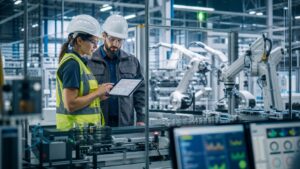
How AI Is Transforming Manufacturing Automation in 2026
AI is transforming manufacturing automation through predictive maintenance, machine vision, adaptive robotics, quality inspection, scheduling, energy optimization, and safer human-machine workflows.
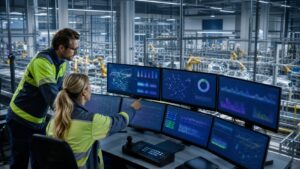
Smart Factories Explained: The Future of AI-Driven Manufacturing
Smart factories use AI, sensors, robotics, digital twins, and connected workflows to make manufacturing more adaptive, visible, efficient, and resilient.
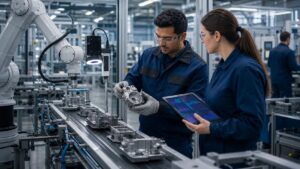
Top Benefits of AI in Manufacturing Automation (With Real Examples)
AI benefits manufacturing automation by reducing downtime, improving quality, optimizing schedules, supporting workers, cutting waste, and making operations more resilient.