
AI is becoming part of the design studio
AI is transforming architecture and design in 2026 because it helps teams explore, analyze, coordinate, and communicate with more speed. The change is not that architects press a button and receive a finished building. Real projects still depend on judgment, codes, budgets, clients, craft, and context. The real shift is that AI can give designers more options earlier, test more constraints before decisions harden, and reduce repetitive work that steals time from creative and technical thinking.
A: No. It changes workflows, but professional judgment and responsibility remain central.
A: Start with one workflow that has clear friction and measurable benefit.
A: It can assist review, but licensed professionals must verify code decisions.
A: Yes when labeled honestly and not presented as resolved documentation.
A: It can if used lazily, which is why strong critique and firm standards matter.
A: Client information, proprietary designs, contracts, budgets, and sensitive site details.
A: It can compare options earlier, but assumptions and sources need review.
A: Yes. AI often becomes more useful when connected to structured project data.
A: They may spend less time on repetitive tasks and more time learning decision logic.
A: More informed iteration while key design choices are still flexible.
From blank page to option space
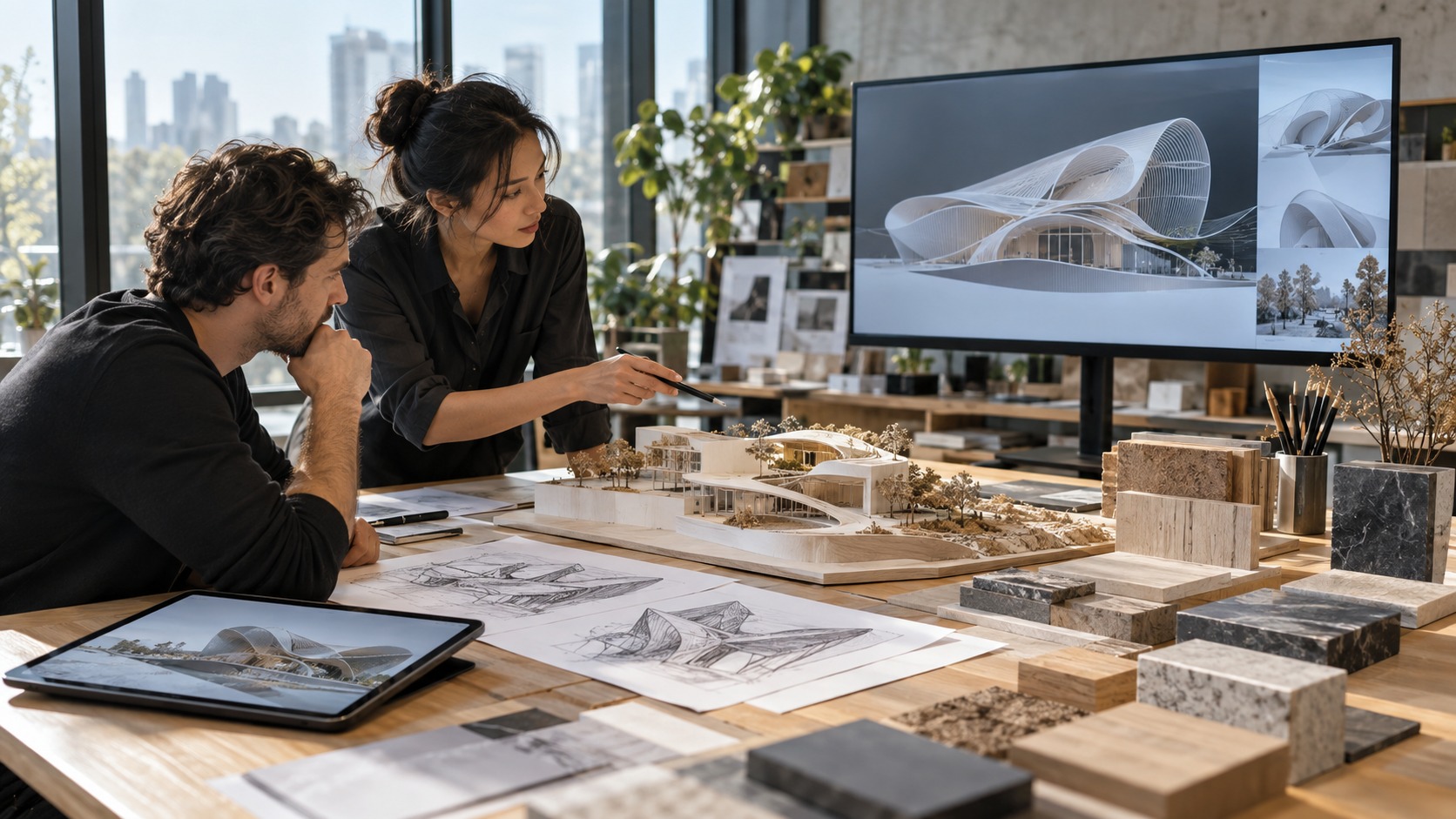
Early design has always involved iteration. Architects sketch, test massing, respond to site conditions, compare precedents, and adjust for client goals. AI expands this option space. Instead of producing one concept at a time, teams can generate multiple massing studies, layouts, facade directions, or spatial arrangements based on constraints they define.
This does not make the first answer the best answer. In fact, one of the benefits is that the team can see more weak ideas quickly and move past them. AI-assisted exploration helps reveal tradeoffs between daylight, views, circulation, density, cost, energy, and user experience before the project becomes too rigid.
The designer’s role becomes more editorial and strategic. The question changes from what can I draw next to which direction best serves the brief, the site, and the people who will use the space.
Analysis moves earlier
In traditional workflows, serious analysis often arrives after the concept has momentum. By then, changing orientation, massing, envelope strategy, or program distribution can be expensive. AI-supported tools are pushing analysis earlier, especially for environmental conditions, embodied carbon, wind, noise, daylight, energy, and site performance.
When analysis is available during concept development, sustainability becomes less of a late correction and more of a design driver. A team can compare several options and understand why one performs better. That makes the conversation with clients more concrete. Instead of saying a scheme feels efficient, designers can discuss the evidence behind that feeling.
The biggest value is timing. Better early feedback can prevent beautiful concepts from becoming technical problems later.
BIM gets more intelligent
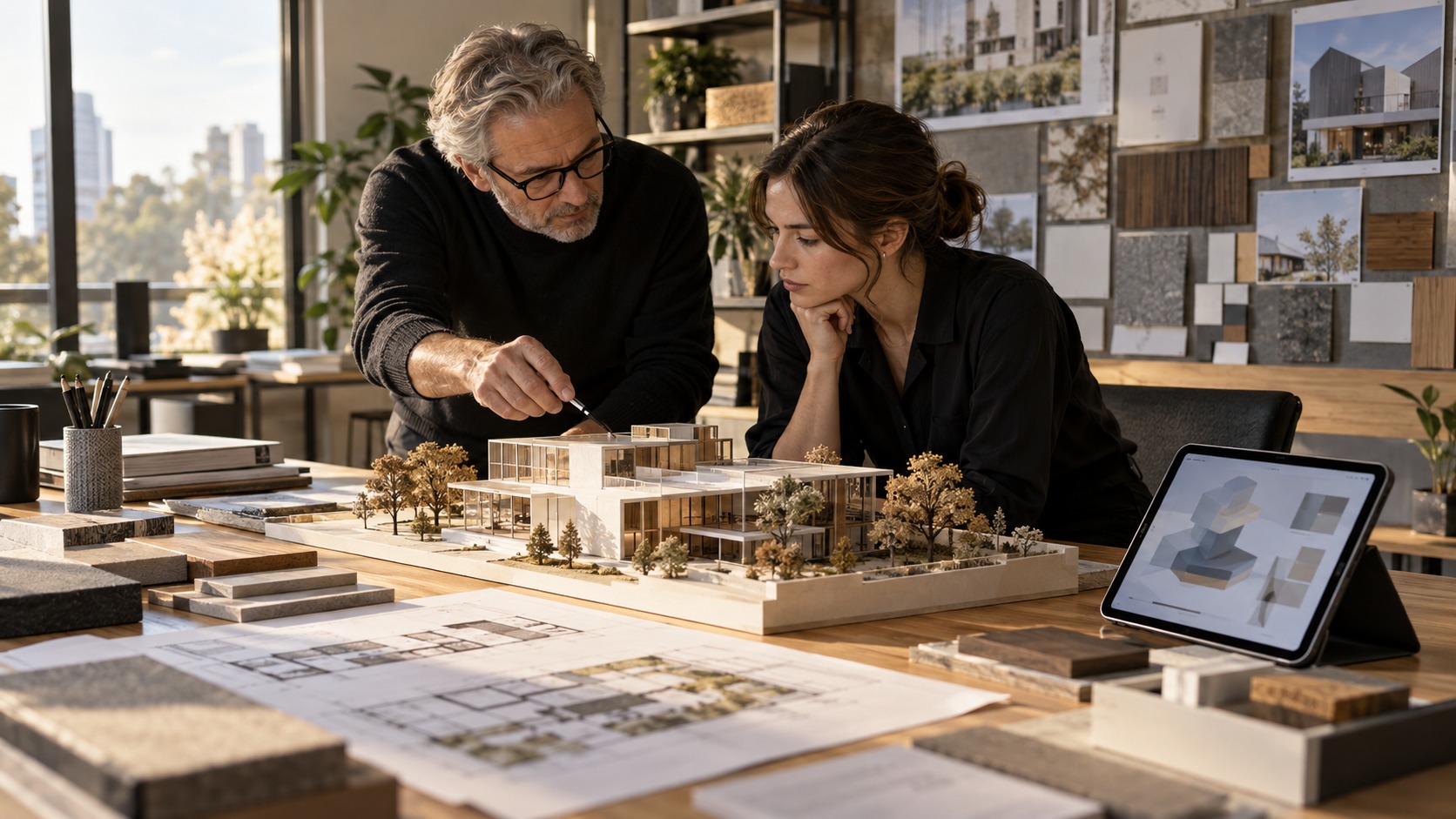
Building information modeling already changed how architects coordinate geometry, documentation, and project data. AI adds another layer by helping teams find patterns, automate repetitive model tasks, identify conflicts, suggest corrections, and connect design decisions to downstream consequences.
A firm might use AI to assist with drawing cleanup, code checks, clash review, material takeoffs, or model classification. None of these tasks is glamorous, but they consume time and attention. When AI reduces the manual drag, skilled staff can spend more energy on decisions that require professional judgment.
The long-term shift is from model as container to model as active project intelligence. The building model becomes a place where teams can ask better questions.
Visualization becomes faster and more iterative
Design communication depends on helping people imagine a future condition. AI image and rendering tools make it faster to explore mood, materiality, lighting, landscape, and user experience. A team can test several visual narratives before committing to a polished direction.
This speed is useful, but it also creates responsibility. Renderings can become too persuasive too early. A beautiful AI-assisted image may imply technical resolution that does not exist yet. Firms need clear internal standards for what is conceptual, what is coordinated, and what is approved.
Used carefully, AI visualization helps clients and communities engage sooner. It gives designers more ways to discuss atmosphere and intent without pretending the image is construction documentation.
Material and sustainability choices improve
Architecture and design decisions carry environmental consequences. AI can help teams compare material options, estimate embodied carbon, evaluate reuse strategies, and connect design choices to performance targets. The earlier these comparisons happen, the more influence they have.
A design team might compare structural grids, envelope assemblies, or material palettes based on cost, carbon, availability, durability, and maintenance. AI can help organize the evidence and show tradeoffs, but professionals still need to verify assumptions and coordinate with engineers, contractors, and suppliers.
The practical benefit is not a magic sustainable building. It is a better decision process where environmental performance is visible when choices are still flexible.
Collaboration changes across disciplines
Architecture is a team sport. Clients, architects, engineers, consultants, contractors, fabricators, and owners all make decisions that affect one another. AI can improve collaboration by summarizing meetings, extracting action items, comparing versions, finding unresolved issues, and helping teams understand project data without digging through scattered files.
This matters because many design problems are coordination problems. A decision made in one discipline can create hidden work for another. AI-assisted project intelligence can help teams see dependencies sooner and reduce the rework that comes from fragmented information.
The firms that benefit most will not simply add AI tools. They will redesign workflows so information moves more clearly from planning to design to construction and operation.
The craft does not disappear
There is understandable anxiety that AI will flatten design into generic output. That risk exists if firms use it as a style machine or accept its first suggestions uncritically. But architecture is not only image generation. It is site interpretation, spatial judgment, technical responsibility, human experience, regulation, material behavior, and long-term stewardship.
AI can produce options, but it does not understand a community meeting the way a thoughtful architect does. It can analyze patterns, but it does not carry professional duty. It can accelerate representation, but it cannot replace the responsibility of making a place that works physically, socially, financially, and environmentally.
The craft changes because some tasks move faster. The need for judgment becomes more important, not less.
What firms should do now
Architecture and design firms should start with specific workflows, not broad promises. Choose one area where AI can remove friction or improve decisions: early site analysis, concept optioning, documentation assistance, visualization, sustainability comparisons, or project knowledge retrieval.
Then set standards. Define when AI output can be used, who reviews it, how client-facing images are labeled, what data can be uploaded, and how the firm protects intellectual property. Train teams to challenge outputs rather than admire them. Track whether the tool actually saves time or improves decisions.
In 2026, AI is not the future of architecture by itself. It is becoming part of the working environment. The firms that thrive will use it to expand design intelligence while staying grounded in responsibility, craft, and the lived reality of buildings.
How education and studio culture are changing
AI is also changing how designers learn. Students and junior staff can generate references quickly, compare spatial options, and ask tools to explain unfamiliar concepts. That can accelerate learning, but it can also hide the slow observational work that builds taste and judgment. Studio culture needs to teach both tool fluency and critical seeing.
Critique becomes even more important. If many people can generate attractive images, the differentiator is the ability to explain why a direction works, what it ignores, and how it could become buildable. A strong studio will ask where the idea came from, what constraints shaped it, and what evidence supports the next move.
The best learning environment treats AI output as material for discussion. It is not a shortcut around design reasoning. It is another object on the pin-up wall.
What clients will notice first
Clients may notice faster visualization before they notice deeper workflow changes. They will see more options, clearer mood studies, and quicker responses after meetings. That can improve engagement because clients often struggle to react to abstract drawings alone.
But speed can create new expectations. If a client sees ten visual directions in an afternoon, they may assume technical changes are just as easy. Architects need to explain the difference between visual exploration and coordinated design development. The image may be fast; the building is still complex.
Firms that communicate this well can use AI to make collaboration more transparent rather than more confusing.
The importance of local context
Architecture is deeply local. Climate, code, labor, materials, culture, site history, community priorities, and maintenance capacity all shape whether a design succeeds. AI tools trained on broad patterns may not understand those conditions without careful direction and review.
That makes local expertise more valuable. A designer who knows the region can use AI to test options while filtering out suggestions that ignore weather, construction practice, or community expectations. The tool expands exploration, but local knowledge keeps the work grounded.
In 2026, the strongest firms will not be the ones that produce the most AI concepts. They will be the ones that combine rapid exploration with place-specific intelligence.
Why implementation should be gradual
Firms do not need to transform every workflow at once. A gradual approach is safer and usually more useful. Start with a repeatable task, such as meeting summaries, early massing comparisons, material research, or internal precedent search. Learn where the tool helps, where it fails, and what review standard is needed.
Then expand to workflows with more consequences. Environmental analysis, BIM assistance, and documentation support can add real value, but they require stronger standards. Teams need to know what has been verified and what remains a suggestion.
Gradual adoption also gives staff time to build confidence. AI becomes part of practice through repeated, reviewed use, not through a single dramatic rollout.
How contracts and deliverables may adapt
As AI enters design workflows, firms may need clearer language in contracts and deliverables. Clients may want to know whether AI-assisted tools are used, what information is protected, and who owns the resulting work. Consultants may need shared expectations about model data, generated visuals, and analysis assumptions.
Deliverables may also need better stage labels. A concept image, a feasibility study, a coordinated BIM view, and a construction document carry different levels of reliability. AI can blur those boundaries visually because early images can look polished. Strong project management restores the distinction.
This is not only a legal concern. It is a trust concern. Clients rely on architects to clarify what has been imagined, what has been tested, and what is ready to build.
Firms that update their language early will have easier conversations later. They can use AI confidently without leaving clients to guess how the work was produced or reviewed.
What should not change
Even as tools change, several responsibilities should remain stable. Architects still need to listen carefully, understand the site, coordinate with experts, protect public safety, communicate honestly, and make decisions that respect the people who will live with the result. AI does not reduce those obligations.
It may actually make them more visible. When options multiply, the reasons for choosing one direction need to be clearer. When images become easier to make, truthfulness about development stage matters more. When analysis becomes faster, verification becomes part of professionalism.
The healthiest transformation keeps the durable values of architecture intact while improving the speed and clarity of the work around them.
For many studios, that balance will become the daily discipline of 2026: move faster where speed helps, slow down where judgment matters, and keep the client, site, and public consequences at the center of the work.